
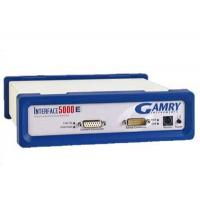
Interface 5000E
The Interface 5000E™ potentiostat is a fully-featured potentiostat/galvanostat for battery testing. It is also ideally designed for testing of fuel cells and supercapacitors. Key features include: •Dual Electrometer •Maximum Applied Potential - ±6 V •Maximum Current - +/- 5A •EIS - 10 μHz - 1 MHz For techniques including: •Electrochemical Energy •Critical Pitting Temperature •Pulse Voltammetry •EIS
Interface 5000E Potentiostat
The Interface 5000E potentiostat is designed for cell-level testing of various energy storage and conversion devices and includes capabilities for monitoring both half cell voltages in addition to the whole cell voltage during an experiment.
Dual Electrometer
A second electrometer gives you the ability to monitor both half cells in a typical three electrode setup. You can monitor both the anode and cathode in addition to the entire cell in charge/discharge experiments and EIS experiments.
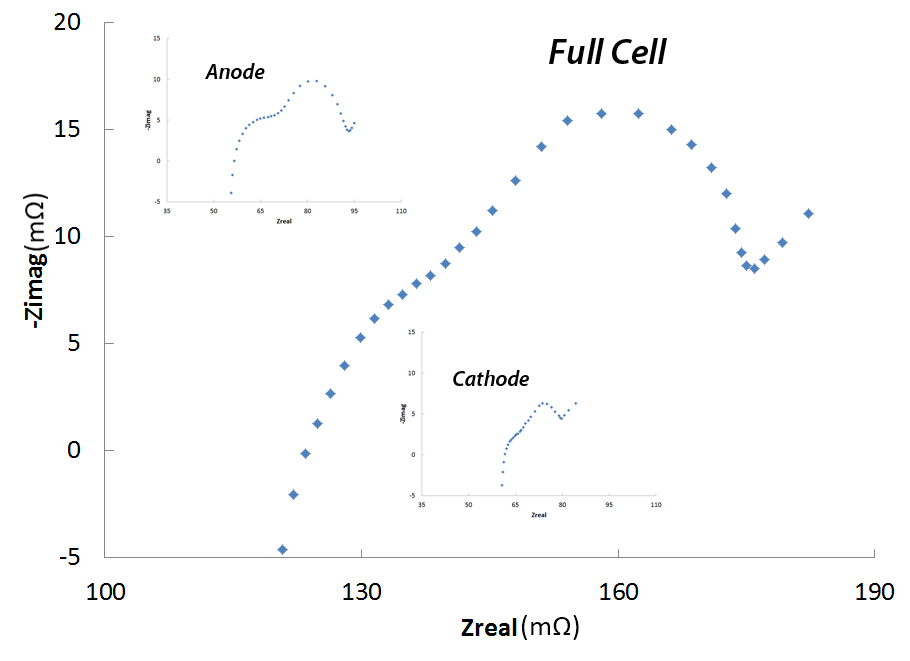
(Click image to Enlarge)
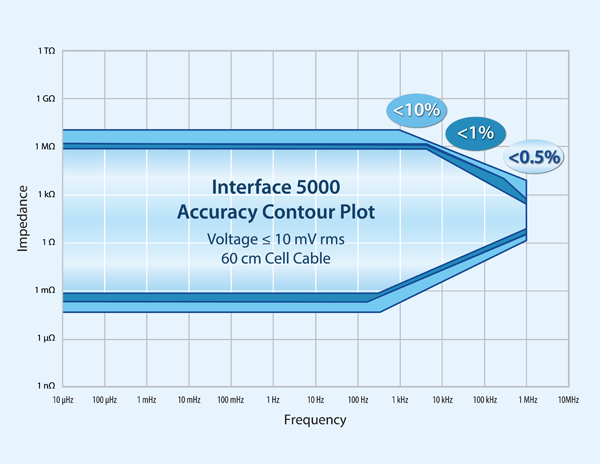
Accuracy Contour Plot
The accuracy contour plot provides a detailed look at the performance you can expect from your instrument in real-world situations. The results include the cell cable. Accuracy contour plots are important because they let you compare the performance of different manufacturers to ensure you are getting the best possible measurement.
Multichannel Potentiostat
The Interface 5000E can be configured as a single-channel potentiostat, bipotentiostat, or multichannel-potentiostat providing you with the flexibility you need to get more done.
Need Less Capabilities? See the Interface 5000P
Below are additional details regarding the capabilities of the Interface 5000E potentiostat. Each bullet point contains a list of the type of techniques available for the potentiostat to run.
Electrochemical Energy – Test single-cells and stacks of various batteries, fuel cells or supercapacitors. Includes charge, discharge, cyclic charge-discharge techniques, potentiostatic, galvanostatic, self-discharge, leakage rate, and read cell voltage.
Electrochemical Impedance Spectroscopy – Includes experimental scripts for potentiostatic, galvanostatic and hybrid impedance spectroscopy experiments in addition to single frequency techniques like Mott-Schottky. We also have our unique power-leveling multisine technique that improves signal-to-noise across the spectrum. On the analysis side, it provides tools for fitting spectra to equivalent circuit models, Kramers-Kronig transform for data validation and a graphical model editor. Our software even includes a script for EIS simulation.
Physical Electrochemistry – Techniques such as cyclic voltammetry, chronoamperometry, and chronopotentiometry and derivatives of these techniques.
Pulse Voltammetry – Techniques such as pulse voltammetry, square wave voltammetry, and associated stripping techniques such as anodic stripping voltammetry.
DC Corrosion – Run standard DC corrosion tests such as polarization resistance, potentiodynamic, cyclic polarization, and galvanic corrosion in addition to a number of others.
Electrochemical Signal Analyzer – Designed specifically for the acquisition and analysis of time-dependent electrochemical noise signals. Cell voltage and current are continuously monitored at rates from 0.1 Hz to 1 kHz. A full featured set of analysis tools provides powerful analysis features such as statistical analysis, detrending, impedance spectra, and histogram analysis.
Electrochemical Frequency Modulation – A non-destructive corrosion rate measurement technique. It allows for measurement of the corrosion rate without prior knowledge of the Tafel constants. In addition, the technique determines the Tafel constants and provides 2 internal validity checks.
Critical Pitting Temperature – Controls a Gamry Potentiostat, TDC4 Temperature Controller, and associated accessories to automatically measure the Critical Pitting Temperature of a material.
Electrochemical Noise – A more general form of electrochemical noise testing. It is also an ECM8 Multiplexer compatible electrochemical noise software package.
eChemDC Toolkit – contains all of the capabilities of the eChemBasic and further extends these capabilities by adding advanced signals and data acquisition modes to simplify implementing experiments like cyclic voltammetry, pulse voltammetry, and dynamic DC corrosion techniques. Also includes more advanced stop tests, particularly useful in fast experiments.
eChemAC Toolkit – Includes full capabilities of eChemDC Toolkit plus allows electrochemical impedance spectroscopy (EIS) and EFM experiments.
Other details
- 2, 3, 4 and 5 electrode measurements
- Measure both half cell voltages in addition to the full cell voltage
- Electrical Isolation
- Floating instrument: use with autoclaves, mechanical stress apparatus, or pipeline probes.
- Portable
- Size of a chemistry textbook, weighing only 3 kgs (6.6 lbs). Easy USB 2.0 connection to a Windows computer.
- Built-In EIS
- On-board DDS to perform EIS from 10 µHz to 1 MHz.
- DSP (Digital Signal Processing) Mode
- Oversamples for improved signal-to-noise and accurate capacitance measurements.
- Current Interrupt iR Compensation
- Gamry potentiostats and their controlling software use control loop algorithms to accurately measure and correct for uncompensated resistance.
- Auxiliary I/O
- Control additional equipment via additional I/O interfaces: external signal input, analog voltage output, analog current output, auxiliary A/D input, and digital I/O connector.
- RTD probe for temperature measurements
- Warranty
- Protected by 2-year factory service warranty.
SYSTEM |
|
| Cell Connections | 2, 3, 4 or 5 |
| Maximum Current | ±5 A |
| Current Ranges | 6 (50 μA – 5 A) |
| Current Ranges (including internal gain) |
8 |
| Minimum Current Resolution | 150 pA |
| Maximum Applied Potential | ±6 V |
| Rise Time | <1 μs |
| Minimum Time Base | 10 μs |
| Noise and Ripple | <20 μV rms |
CONTROL AMPLIFIER |
|
| Compliance Voltage | ±8.5 / ±2.5 V |
| Output Current | >±5 A |
| Speed Settings | 5 |
| Unity Gain Bandwidth | 1050, 250, 43, 4.4, 0.5 kHz |
EIS MEASUREMENT |
|
| EIS | 10 μHz – 1 MHz |
| EIS Accuracy | See Accuracy Contour Plot |
| Voltage AC Amplitude | 3 V maximum |
| Current AC Amplitude | 5 A maximum |
ELECTROMETER |
|
| Input Impedance | >1012 Ω || <2 pF |
| Input Current (typical) | <25 pA |
| Bandwidth | >12 MHz at -3 dB |
| CMRR | >98 dB (10 kHz) >88dB (100 kHz) |
POTENTIAL |
|
| Applied Accuracy | ±1 mV ±0.2% of setting |
| Applied Resolution | 200 μV, 50 μV, 12.5 μV/bit |
| Measured Accuracy | ±0.5 mV ±0.2% of reading |
| Measured Resolution | 200 μV, 20 μV, 2 μV/bit |
CURRENT |
|
| Applied/Measured Accuracy | ±25 pA ±0.05% of range ±0.2% of value |
| Applied/Measured Resolution | 0.0033% full-scale/bit |
| Bandwidth | >5 MHz (5 mA) |